
Project management is the operating system of every successful software development. But those who start a new project often get caught up in the search for the one, perfect model. The truth is: there is no universal answer in the duel agile vs. waterfall. Success depends on which project management model provides the right framework for your individual goals and your team.
Those who rigidly rely on a method that doesn't fit the market environment waste valuable resources and lose touch. Why is this the case? In our daily work as a digital agency, we experience that the decision often becomes a matter of belief. Yet the project model is merely a tool. A rigid requirements specification offers security, but can quickly become a millstone in a dynamic market. Those who enforce agility without planning, on the other hand, ultimately pay a high price for poor results.
What's behind the Agile and Waterfall methods?
How you organize your project is the invisible framework of your success. It determines whether your team works efficiently or gets lost in bureaucratic loops. Essentially, it's about how we structure the path from the initial vision to the finished product.
Rigid planning or sprints: Where are the differences?
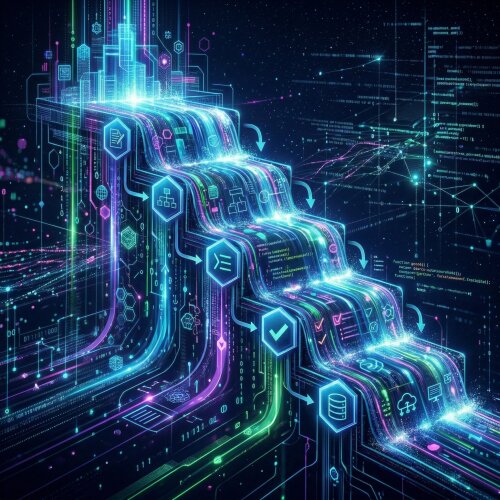
The name "Waterfall model" is programmatic: like a real waterfall, the project cascades from one stage to the next – from analysis through design to programming. Physically and procedurally, nothing flows back here. Winston W. Royce described the model in 1970 in the context of software development.
Its sequential structure resembles classic construction projects, where individual phases clearly follow one another and later changes cause high costs. Although Royce described the waterfall model in 1970 in the context of large software systems, practice quickly showed its limitations in the following decades.
Software projects fundamentally differ from construction projects: requirements are rarely completely known, markets change, and user needs evolve dynamically. As early as the 1980s and 1990s, iterative approaches emerged that aimed to reduce risks through incremental procedures. The Agile Manifesto of the Agile Alliance defined the formal framework for this development in 2001.
The central difference between agile vs waterfall thus lies in adaptability.
While the waterfall model works toward a comprehensively planned overall release ("Big Bang"), agile methods break a project down into small, verifiable units. These short development cycles – often referred to as iterations or sprints – enable continuous learning, early feedback, and targeted course corrections. Agility is thus not a trend, but a structural response to uncertainty and change dynamics.
Theory vs. Reality: How do the models work in practice?
In practice, the difference between agile vs waterfall becomes particularly evident in the project structure. In waterfall projects, an intensive definition phase comes at the beginning. Here, a so-called requirements specification is created – a detailed document in which all requirements, functions, interfaces, and framework conditions are completely described. This document forms the binding basis for planning, budget, and implementation. Changes are possible later, but these formal requests drive up costs.
The logic behind this is clear: the more precise the planning, the more controllable the project. This creates security – particularly with regulatory requirements, complex system landscapes, or fixed budgets.
Agile methods reverse this sequence. Here, you don't start with a complete requirements catalog, but with a prioritized list of functions (backlog) that are implemented step by step. Instead of an immutable document, the product emerges iteratively. In short development cycles, functional interim results are delivered that can be immediately evaluated and adjusted.
Waterfall tries to minimize uncertainty through planning. Agile tries to master uncertainty through learning.
Spectator or player: Where does the customer's role remain?
Those who choose between agile and classic project management essentially decide how deeply they look into the process. The models differ massively in how much control customers can exercise during the project:
- The passive role in waterfall: The direction is defined at the beginning and the goal is delivered at the end. This saves time resources on the customer side during the project, but massively restricts adaptability if priorities change during the course.
- The active role in agility: Through close customer involvement in each sprint, the client becomes an integral part of the team. The risk of misdevelopment is minimized by continuously validating and adjusting interim results.
- Methodology as a decision aid: The waterfall method is particularly suitable for projects with fixed regulatory guardrails. Those who plan a website or app with high market dynamics, however, benefit from the agile freedom to adjust the course at any time.
Security through structure: What can the waterfall model really do well?
Good software sometimes needs more than just quick sprints; it needs a stable common thread. The waterfall model is always the right choice when "slavishly following rules" is meant in a positive sense – namely with security audits or strict regulatory requirements.
In the world of web development, you use this model specifically for aspects that tolerate no uncertainty:
- Definition of core functions: Before you tackle the "freestyle" in design, waterfall clarifies the "mandatory" technical architecture.
- Security through planning: A solid foundation prevents technical sloppiness or inconsistent spacing from emerging in the first place, because the system is thought through from the ground up.
- Reliable documentation: For demanding SMEs, clean documentation is the key to being able to safely scale the product even years after launch.
The agile organism: Flexibility as the greatest competitive advantage
While the waterfall model follows an immovable blueprint, agility resembles a living organism that responds to its environment. In markets that don't forgive long waiting times, this response speed becomes the decisive competitive advantage:
- Sprints instead of long-distance running: Instead of waiting months for a final result, tangible interim results emerge in short sprints. This makes it possible to continuously check the quality of the user experience and sharpen the product directly based on real user feedback.
- Course corrections as standard: In dynamic projects, changes are not a disruptive factor, but an opportunity. Agile processes allow you to readjust the course at any time when market conditions or requirements change during runtime.
- Protection against "missing the point": Through constant exchange between team and stakeholders, it is ensured that no soulless functions emerge that nobody needs in the end. This minimizes the risk of investing valuable resources in the wrong direction.
The direct comparison: Find the match for your requirements
The choice of model depends massively on the framework conditions of your project. So that you don't sink into "agile chaos" or land in the "waterfall prison," a look at the core requirements helps:
| Requirement | Waterfall (Classic) | Agile Project Management (Modern) |
|---|---|---|
| Market environment | Stable: Ideal when framework conditions hardly change during runtime. It offers security in a static environment where the target image is immutable from the start. | Dynamic: Enables quick response to new trends or competitive pressure. The project remains flexible enough to react to market changes in real time. |
| Project goal | Regulatory: The focus is on compliance, complete documentation, and adherence to fixed requirements. Security audits and legal requirements can be precisely mapped in this linear process. | Explorative: Perfect for developing prototypes and genuine innovations. The target image is sharpened through experimentation and direct learning during implementation. |
| Budget & Planning | Fixed budget: Costs are calculated in advance based on a detailed requirements specification. This offers maximum planning security for companies with rigid budget cycles, but carries the risk of change requests when changes occur. | Flexible investment: The budget flows iteratively into the most valuable functions (backlog). It enables efficient resource management, as investment is always directed where the greatest added value emerges. |
| Customer involvement | Selective: Involvement occurs primarily in the definition phase and at final acceptance. This conserves time resources on the customer side, but requires blind trust in the original planning. | Continuous: The client is closely integrated into each sprint as a strategic partner. Through constant feedback, it is ensured that the product precisely meets user expectations. |
| Team size | Large teams: Fixed structures and clear hierarchies help coordinate hundreds of tasks across different departments. Role distribution is firmly defined and provides orientation in complex organizations. | Small teams: Cross-functional teams act largely autonomously and self-responsibly. Short communication paths enable significantly higher implementation speed and individual excellence. |
Why is there no universally valid project model?
The choice of methodology often determines whether a project runs smoothly or becomes a resource trap. Each model brings its own strengths and pitfalls, which is why a universal "best practice solution" for all projects remains an illusion.
While one team needs structure to map regulatory requirements in the backend, another team must work exploratively to find innovative solutions. A wrong model inevitably leads to friction losses that jeopardize project success. That's why a third option has emerged in practice.
Best of Both Worlds: Are hybrid approaches the perfect middle ground?
Often, the decision between agile and classic project management is not an either-or question. Hybrid models combine the structured planning of the waterfall method for the strategic framework with agility in implementation. This creates stability where it's needed and freedom where it provides the greatest added value.
- Practical implementation: The rough roadmap, budget, and milestones are fixed according to the waterfall model. Within these phases, the team works in agile sprints to iteratively refine functions.
- The self-test: A hybrid approach is ideal when strategy and regulatory guardrails are fixed, but the user experience (UX) needs to be optimized through continuous feedback.
- The downside: Hybrid approaches often mean higher management effort. You forego the pure speed of fully agile teams and retain some of the bureaucratic burden of waterfall. Additionally, there is a risk of friction losses at the interfaces between rigid plans and flexible development.
Conclusion
There is no universal winner in the duel agile vs waterfall; the choice of method must consistently subordinate itself to the goals and market environment. While the waterfall model shines through planning security with fixed regulatory framework conditions, agile methods prove to be engines for innovation and adaptability in dynamic markets. Hybrid approaches offer a stable strategic framework without sacrificing the necessary iterative freedom in implementation.
Ready for the right strategy? The choice of the appropriate project management model determines the success of your digital vision. We support you in selecting the right methodology for your software development.