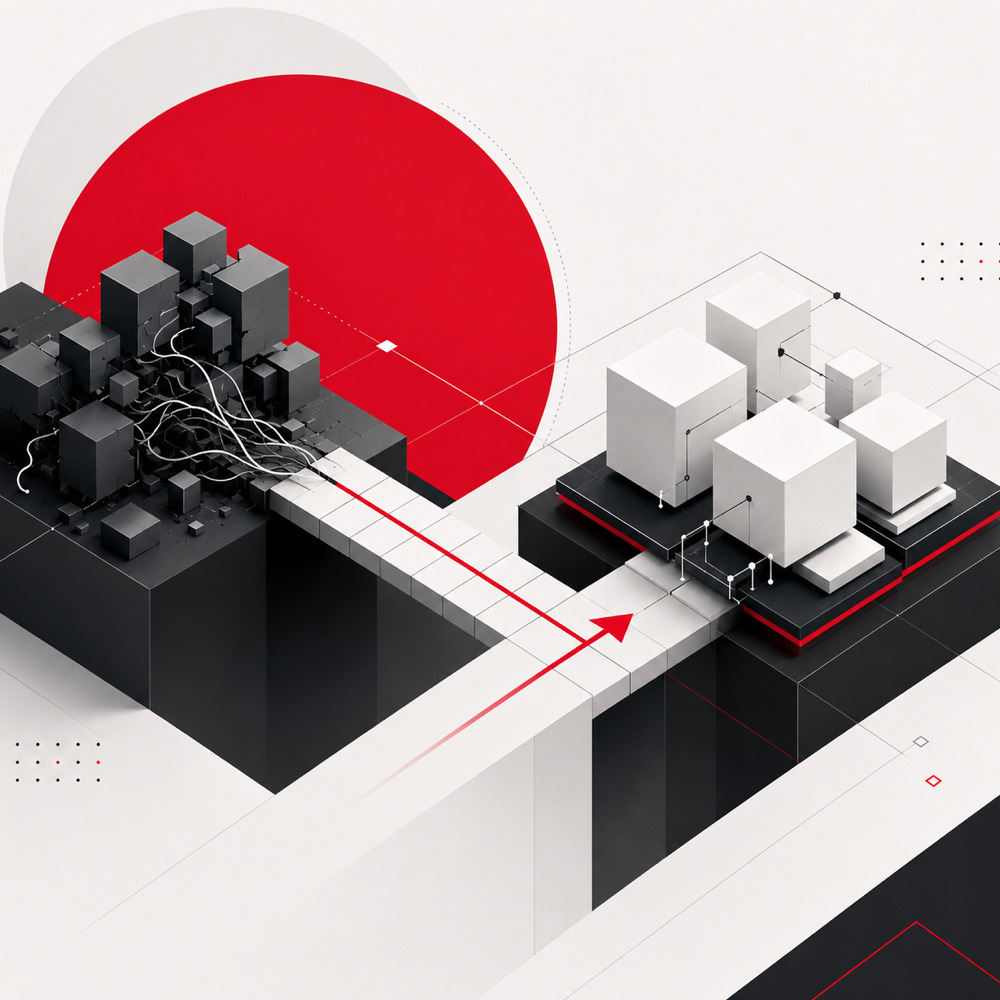

A clear trend is emerging in software development: away from monolithic structures, towards modular architectures. But what's behind this shift? Is it just a short-lived trend or a necessary evolution for growing systems? This article illuminates the path from monolithic to modular applications and shows in practical terms how a step-by-step transformation can succeed – without completely rebuilding the existing system.
What does "modular" actually mean – and why does everyone suddenly want to move away from the monolith?
Before we dive deeper, we should clearly define the terms:
A monolith is an application where all functions and components are united in a single codebase. Everything is tightly interwoven, from the database to the user interface. Changes in one area can have unintended effects on other parts.
A modular architecture, on the other hand, divides the application into separate, independent modules. Each module has clearly defined boundaries and responsibilities. Communication between modules occurs via defined interfaces.
The monolith is not inherently "bad" – many successful applications began as monoliths and functioned excellently for a long time. But with growing complexity and increasing demands on scalability and maintainability, monolithic architectures reach their limits.
Modular systems offer decisive advantages:
- Better maintainability: Changes in one module have minimal impact on others
- Parallel development: Teams can work independently on different modules
- Scalability: Modules can be scaled independently as needed
- Technology freedom: Different modules can use different technologies
- Testability: Modules can be tested in isolation
These advantages become particularly relevant when systems grow and teams become larger. The desire for control, order and efficient scaling drives the development towards modular architectures.
The pitfalls of the monolith – and when modularization makes sense
Monolithic systems show typical symptoms when they reach their limits:
Long build and deployment cycles
Even small changes require building and deploying the entire application. What takes seconds in small projects can grow to minutes or even hours in large monoliths.
Code dependencies across numerous functions
In monolithic systems, unintended dependencies often arise. A change in the user module can suddenly affect the order system without there being a logical connection.
Error propagation through the entire system
A bug in one part of the system can crash the entire application. Troubleshooting becomes complex, as potentially any part of the system could be affected.
Limited team autonomy
Teams cannot work independently of each other, as they operate on the same codebase. Releases must be coordinated, leading to delays and conflicts.
Technological stagnation
Introducing new technologies or frameworks becomes difficult, as they would affect the entire application. This often leads to technological standstill.
Modularization makes particular sense when:
- The system is continuously growing and becoming more complex
- Multiple teams are involved in development
- Time-to-market should be shortened
- Different parts of the system have different scaling requirements
- Maintenance costs are rising and changes are becoming increasingly risky
Modularizing ≠ Microservices – a realistic start with modules
A common misconception is equating modularization with microservices. In fact, there is an important intermediate step: the modular monolith.
| Monolith | Modular Monolith | Microservices |
|---|---|---|
| Unified codebase | Separated modules in one codebase | Completely separated services |
| Shared database | Often shared database with clear responsibilities | Separate databases per service |
| One deployment | One deployment, but clearly separated components | Separate deployments |
| High coupling | Loose coupling between modules | Complete decoupling |
The modular monolith offers a pragmatic entry into modularization without having to immediately deal with the complexity of microservices. You don't have to tear everything apart right away to think anew.
In PHP projects, modularization can be achieved through various techniques:
- Composer packages: Outsource functionalities into separate packages
- Namespaces: Clear structuring through PSR-4-compliant namespaces
- Dependency Injection: Reduce coupling through IoC containers
- Interfaces: Define clear contracts between modules
- Event system: Communication between modules via events instead of direct calls
Frameworks like Laravel or Symfony already offer good prerequisites for modular structures through their package or bundle systems.
Step-by-step to modular structure – Here's how to proceed concretely
The transformation of a monolith into a modular structure is a step-by-step process:
1. Analyze and understand the codebase
Before you begin modularization, you must understand the existing codebase:
- Identify logical domains (e.g. users, orders, billing)
- Recognize natural boundaries between functionalities
- Analyze data flows and dependencies
Tools like PHPMetrics, PHP Depend or even manual code analysis can help identify structures and dependencies.
2. Identify and reduce dependencies
Dependencies are the key to modularization. The goal is to minimize and control them:
- Use tools like
deptracorphpmetricsto visualize dependencies - Identify cyclic dependencies that need to be resolved
- Implement the Dependency Inversion Principle to control dependency directions
3. Design modules and define boundaries
Now it's about drawing clear module boundaries:
- Define responsibilities per module (Single Responsibility Principle)
- Create clear interfaces between modules
- Implement separate namespaces for each module
- Set up autoloading according to PSR-4
In Laravel, for example, you could create packages like company/billing or company/user-management, each with its own structure and responsibility.
4. Adapt tests to modularity
Tests are crucial for successful modularization:
- Write unit tests for the core functionalities of each module
- Implement integration tests for communication between modules
- Use mocks for external dependencies to test modules in isolation
Good test coverage gives you security during restructuring and helps identify unintended side effects.
5. Gradual implementation and refactoring
The actual implementation should be done step by step:
- Start with a non-critical module as a pilot project
- Refactor code into the new module without changing functionality
- Test thoroughly after each change
- Iterate and improve continuously
6. Evaluate separate deployment strategies (optional)
As an advanced step, you can think about separate deployment strategies:
- Implement feature flags for new module features
- Consider CI/CD pipelines per module
- Plan a strategy for database migrations
Tools and technologies that help you modularize
The right tools can significantly facilitate the modularization process:
For PHP projects
- Composer: Essential for package management and modularization
- PHP-DI / Symfony DependencyInjection: For clean dependency injection
- deptrac: For analyzing and enforcing dependency rules
- PHPStan / Psalm: Static code analysis to identify problems
- PHPMetrics: Visualization of code quality and dependencies
Framework-specific tools
- Laravel Packages: Enable creation of custom packages within Laravel
- Symfony Bundles: Modular components in Symfony
- Laravel Modules: A package for easier modularization of Laravel applications
Architecture concepts
- Domain-Driven Design (DDD): Provides concepts for structuring complex domains
- Clean Architecture: A layer model for clear separation of responsibilities
- Hexagonal Architecture: Focuses on separating business logic from external dependencies
The choice of the right tools depends heavily on your specific project and the technologies used. For Laravel projects, different solutions are suitable than for Symfony or other frameworks.
Challenges along the way – and how to master them
Modularization brings specific challenges:
Delimiting modules
One of the most difficult tasks is the sensible delimitation of modules:
- Solution: Orient yourself to business domains rather than technical aspects
- Tip: Use Event Storming or Domain Storytelling to identify domain boundaries
Handling shared data
Modules often need access to the same data:
- Solution: Define clear ownership for data and implement access layers
- Tip: Consider CQRS (Command Query Responsibility Segregation) for complex data access patterns
Technical debt
Existing technical debt makes modularization more difficult:
- Solution: Identify critical debt and plan its reduction parallel to modularization
- Tip: Use the "Boy Scout Rule" – leave every code you touch in a better state
Team structure and communication
Modularization requires adjustments in team structure:
- Solution: Align teams according to modules (Feature Teams instead of Component Teams)
- Tip: Establish clear responsibilities and communication channels between teams
Deployment complexity
With increasing modularization, deployment complexity increases:
- Solution: Invest early in CI/CD pipelines and automation
- Tip: Implement comprehensive monitoring and logging to quickly identify problems
The path to modularization doesn't get easier, but more controllable. With each successfully modularized part of your system, you gain more flexibility and scalability.
A real use case: Modularization in a PHP project with Laravel
To make the theory more tangible, let's look at a concrete example from our practice:
An e-commerce system developed as a Laravel monolith reached its limits with a growing user base. Especially the billing system became a bottleneck – every change required extensive testing of the entire system, and development speed declined.
Initial situation:
- Monolithic Laravel application
- Tightly interwoven components (products, orders, billing, users)
- Long deployment cycles (approx. 45 minutes for complete deployment)
- High error susceptibility with changes
Approach:
- Analysis: Identification of the billing module as a critical but relatively isolated area
- Modularization: Creation of a
company/billingpackage within the Laravel project - Interfaces: Definition of clear interfaces for communication with other modules
- Refactoring: Gradual relocation of billing logic into the new module
- Tests: Comprehensive unit and integration tests for the new module
- CI/CD: Setup of a separate CI/CD pipeline for the billing module
Results:
- Development speed: Changes to the billing module could be implemented 70% faster
- Error rate: Reduction of errors with changes by 60%
- Deployment time: Separate deployments of the billing module in under 10 minutes
- Team autonomy: The billing team could work independently and establish their own release cycles
This approach shows that even without complete conversion to microservices, significant improvements can be achieved through modularization. The modular monolith served as an intermediate step that already brought most of the advantages without introducing the full complexity of microservices.
Conclusion – Modular systems are not a fad, but the future
The modularization of software systems is not a passing trend, but an answer to the growing complexity of modern applications. It's not about writing "cooler" code, but about tangible advantages:
- Scalability: Modules can be scaled independently of each other
- Maintainability: Changes remain locally limited and less risky
- Development speed: Teams can work in parallel and independently
- Technological flexibility: Modules can be implemented with different technologies if needed
- Resilience: Errors in one module do not affect the entire system
The path from monolithic to modular is not a sprint, but a marathon. It's not about changing everything at once, but proceeding step by step and in a controlled manner. Every step towards modularity is a step towards future viability.
If you want to grow, you must learn to separate. This wisdom applies not only to personal growth, but also to software systems. The ability to decouple components and develop them independently is the key to long-term success in software development.
Do you need support in modularizing your system or would you like to learn more about modern software architecture? Our experts are happy to help you find the right path for your project.