
How much time does your team spend daily synchronizing information between Jira, Slack, Excel, and the CRM system? In modern project organization, this "complexity trap" is one of the biggest productivity killers. Classic software solutions manage tasks. But they don't solve them. The use of Artificial Intelligence in companies promises a cure. But reality often looks different: silos often prevent AI agents in project management from understanding the context.
Only when we understand our tech stack as a networked "Mission Control" does a passive tool become an active player. Through our expertise in web development, we show you the path for autonomous agents. With the Model Context Protocol (MCP), you let your data work intelligently for you.
Mastering AI Agents in Companies: How MCP Unlocks Your Data Treasures
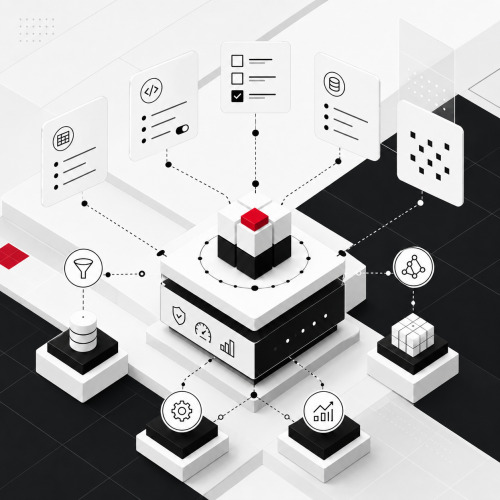
Why does Artificial Intelligence in companies often fail in everyday operations? The AI often acts like a genius in an empty room. It has no access to the file folders in the next room. This is where the MCP server comes into play. In the analogy, it's like a highly qualified secretary. It sits directly at the data source (e.g., your database, your ERP, or your note-taking program). When the AI has a question about project status, it doesn't laboriously query each tool individually. Instead, it turns directly to the secretary (the MCP server).
This searches for the information in the right format and gives it to the AI. The MCP server acts as a "universal adapter". It structures your scattered project data so that the AI no longer guesses but accesses facts. For modern project organization, this means: the AI transforms from an isolated text generator to an informed team member. It has access to the "Single Source of Truth". Want to learn more about MCP servers? Read our MCP Server Strategy Guide.
Multi-Agent Systems: The Orchestra of Productivity
The revolution of AI agents for companies lies in the interaction of specialized agents. When the MCP server provides the common sheet music, the agents function as musicians. They react to each other in real-time. Instead of relying on a generalist AI, we establish a structure of highly specialized experts. These act more precisely in depth than an AI that only works in breadth:
- Autonomous role distribution: A "budget agent" permanently monitors cost centers. If it registers a deviation, it doesn't write a report. It immediately briefs the "resource agent". This immediately checks the capacities in Jira and Google Calendar to calculate alternative scenarios.
- The end of manual search: In a conventional structure, project managers spend a lot of time reconciling information. Multi-agent systems end this "information tourism". Each agent has access to the identical data basis via the MCP universal adapter. The manual compilation of Excel lists and Slack protocols is eliminated.
- From administrator to conductor: The AI takes over the detailed coordination in the background. Humans move into the role of conductor. They evaluate the options prepared by the agents and provide the final strategic direction.
The "Mission Control" Logic
Problem: Information is trapped in silos (Slack, Jira, ERP). The AI "hallucinates" because it lacks context. Solution: Multi-agent systems via MCP. While humans take on creative leadership, they delegate routine tasks to specialized agents:
- Agent A (Controller): "Budget for Task X is 90% exhausted."
- Agent B (Planner): "I see 20 open hours in Jira. I suggest resource reallocation."
Result: A ready decision proposal on your dashboard – even before the problem escalates.
How Do You Get from Static Lists to Proactive Project Navigation?
Through the permanent background work of AI agents, the manual compilation of outdated status updates is eliminated. The PM no longer acts as a data aggregator. They become the final control instance that validates AI-generated decision templates. This transformation ends reactive administration. The project manager becomes a proactive navigator and gains time for real leadership.
| Dimension | Data Aggregation (Past) | Navigation Support (Future) |
|---|---|---|
| Response Time | Reactive: Problems only become visible in reports. | Predictive: Warning occurs before the bottleneck. |
| Decision | Based on static status reports. | Based on live context and simulations. |
| PM Focus | Administration and information gathering. | Interpretation, control, and stakeholder leadership. |
How Do You Achieve Security and Sovereignty with Autonomous AI Systems?
Skepticism toward cloud AIs is justified. This especially applies to business secrets and personal data. Those who want to increase productivity with AI must not leave security to chance. Local MCP structures offer an architectural advantage here. They enable granular access control directly at the source. Instead of granting an AI blanket access to folders, the MCP server defines exactly which resources are released.
Compared to public cloud interfaces, this approach drastically minimizes the attack surface. An intelligent agent only communicates with the locally hosted MCP gateway. The gateway in turn protects the business logic of your application. This guarantees compliance with European data protection standards (GDPR). It also ensures more stable performance, as data paths remain short. Sovereignty means in the Agentic Web: The AI comes securely to your data – your sensitive data doesn't wander uncontrollably to the AI.
Conclusion
In summary: The "complexity trap" cannot be solved with even more software silos. The answer lies in their intelligent networking. An autonomous agent that accesses your "Single Source of Truth" via MCP changes everything. It transforms the project manager from being driven to being a sovereign navigator.
The technological basis with Laravel MCP is ready. With it, you unlock your data treasures securely and in compliance with GDPR. The transition to proactive project control is no longer a distant dream. It's a tangible solution for agile companies. Use the intelligence of multi-agent systems. Let's work together to set up your MCP server and implement customized AI agents for companies.